
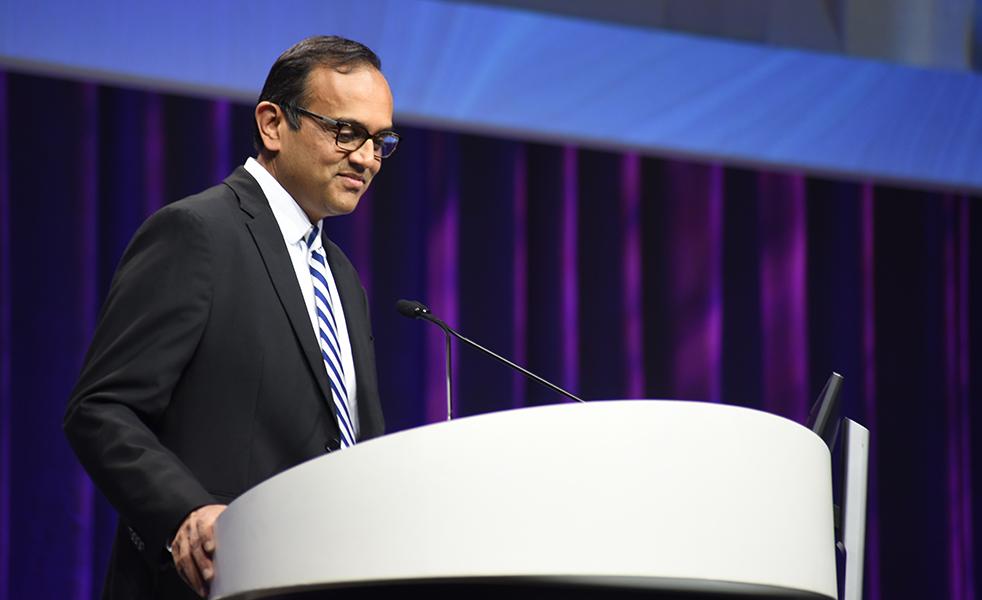
Manesh Patel, MD, officially begins his term as president of the American Heart Association on July 1, stepping into one of the most visible volunteer leadership roles in cardiovascular health with a perspective shaped by decades of experience in clinical care, evidence generation, and team-based research.
For the Duke Clinical Research Institute (DCRI), Patel’s presidency is more than a national leadership milestone. It reflects how the DCRI’s approach to clinical research continues to shape cardiovascular science and health around the world by asking consequential questions, testing ideas rigorously, and moving proven findings into practice.
“Science matters, and science saves lives,” Patel said.
That belief has been a throughline in Patel’s career as a physician-scientist, Duke cardiology leader, and senior investigator at the DCRI. His work has focused on cardiovascular disease, clinical trials, and improving the way evidence is developed and applied to care.
Patel credits the DCRI with helping shape not only the questions he asks, but the way he approaches leadership and impact.
“My colleagues, my patients, and our teams at the DCRI have taught me the humility and the importance of asking and answering questions,” he said.
For Patel, the discipline in identifying the right question, assembling the right team, and generating evidence that can change practice is central to improving health at scale.
“I love applying science and having questions that then I can actually work with teams to answer,” he said.
The challenge, Patel said, is not only the discovery. It is ensuring that discoveries are tested, validated, and delivered in ways that reach the patients and communities that need them.
“Our opportunity is not only to discover and prove therapies and diagnostics for clinical care, but to make sure those proven things get to everyone, everywhere,” he said.
That emphasis closely mirrors DCRI’s role in the research ecosystem, translating scientific questions into evidence through clinical trials, data science, outcomes research, and collaborations that span institutions, disciplines, and communities.
Patel’s AHA presidency offers an opportunity to help carry out the mission of the AHA to ensure health and hope for everyone everywhere. Patel is focused on the idea that the promise of science is realized when evidence reaches practice.
The stakes are high. The American Heart Association has projected that a majority ofU.S. adults could have a form of cardiovascular disease by 2050, with related costs expected to triple. Those projections emphasize the need not only for new discoveries, but also for better systems to generate evidence, close gaps, and move what works into broader use.
“If we don’t do something to bend that curve, by 2050 nearly 50% of people may have some form of cardiovascular disease or risk factors for it,” Patel said. “This is the biggest opportunity we have to impact human health.”
In that context, Patel’s leadership of the AHA can be seen as an extension of the work that has defined his career: bringing science, clinical practice, and implementation together so that evidence-based advances can improve health for more people.
Patel is also quick to frame leadership as collective work. His own career, he said, has been made possible by teams—at Duke, at the DCRI, at the American Heart Association, and across the broader cardiovascular research community.
“I get to do the things I’m doing because I am part of teams … and I get to stand on the shoulders of so many giants,” he said.
Patel’s presidency also reflects the depth of cardiovascular leadership at the DCRI and Duke Health. Svati Shah, MD, MHS, also a DCRI cardiologist and Duke physician-scientist, has been named the AHA’s volunteer president-elect for 2026-27 and is expected to succeed Patel as volunteer president.
“I’m so excited that Svati will be in this role after me,” Patel said. “I’m so glad I’m going first because she’s a hard act to follow. In all seriousness, Svati is a force for good, and I am excited to partner with her.”
That team-based ethos is deeply aligned with DCRI’s model of research, where faculty, operational experts, statisticians, project leaders, clinicians, and partners work together to answer the questions that no individual could answer alone. It also reflects Patel’s view of leadership as a responsibility grounded in service.
“Leadership is often a service — a service to others and a service to our patients,” he said.
As he begins his term leading the AHA, Patel represents not only his own contributions to cardiovascular medicine, but also the people and institutions that helped shape his approach to science. For the DCRI, his presidency is a reminder of the institute’s enduring influence: developing leaders, advancing evidence, and helping move proven science toward broader health impact.
“It is the thing that makes me get up in the morning,” Patel said, “applying science and proven therapies to improve people’s health.”
Read more about Dr. Patel's journey and vision for his AHA presidency.